Monday, March 24, 2008

Planting Time

Over the weekend I planted out 75 strawberry plants. 5o of them are June bearing, and 25 are everlasting. I planted them carefully and then covered them with a thick blanket of straw because I knew that it would dip into the 30s for the next few nights. I also planted cabbage, peas, beans, radish, rutabega and lettuce in a seperate bed. I covered the beans with straw to protect them from the cold as well. I purchased some Johnny Jump ups and planted them and I also acquired a rosemary and lavendar plant. I still haven't decided how I will design my herb garden yet.

Planting was back breaking work but I felt quite satisfied when I was finished. I am still trying to decide where to till up a new garden, the site that I had wanted to plant is filled with gravel (quite suitable for lavendar) so now I must come up with a new plan. I also need to find a way to fence in the garden to keep the chickens out! They have already been scratching the straw off my strawberry beds and I don't want them to eat all of the seedlings. When the plants are strong and mature I will allow them in the garden on a limited basis to help with bug control.


Wednesday, February 13, 2008

THE GREAT BACKYARD BIRD COUNT

Well, there are only two days left until the GREAT BACKYARD BIRD COUNT! Dust off your field guides, and get your binoculars ready to count the birds. See the bottom of the page for links on how to identify birds that you are most likely to see in your backyard.

You can submit your results here:
http://gbbc.birdsource.org/gbbcApps/input

WHAT IS THE GBBC you ask??
The Great Backyard Bird Count is an annual four-day event that engages bird watchers of all ages in counting birds to create a real-time snapshot of where the birds are across the continent. Anyone can participate, from beginning bird watchers to experts. It takes as little as 15 minutes. It’s free, fun, and easy—and it helps the birds.


Participants count birds anywhere for as little or as long as they wish during the four-day period. They tally the highest number of birds of each species seen together at any one time. To report their counts, they fill out an online checklist at the Great Backyard Bird Count web site. As the count progresses, anyone with Internet access can explore what is being reported from their own towns or anywhere in the United States and Canada. They can also see how this year's numbers compare with those from previous years. Participants may also send in photographs of the birds they see. A selection of images is posted in the online photo gallery. In 2007, participants reported a record-breaking 11 million birds of 616 species. They submitted more than 80,000 checklists, an all-time record for the ten years of the count.

Why Count Birds?
Anna's Hummingbird. Photo by JackDoyle, OR, 2007 GBBC participant
Scientists and bird enthusiasts can learn a lot by knowing where the birds are. Bird populations are dynamic; they are constantly in flux. No single scientist or team of scientists could hope to document the complex distribution and movements of so many species in such a short time.We need your help. Make sure the birds from your community are well represented in the count. It doesn't matter whether you report the 5 species coming to your backyard feeder or the 75 species you see during a day's outing to a wildlife refuge.

Your counts can help us answer many questions:
How will this winter's snow and cold temperatures influence bird populations?
Where are winter finches and other “irruptive” species that appear in large numbers during some years but not others?
How will the timing of birds’ migrations compare with past years?
How are bird diseases, such as West Nile virus, affecting birds in different regions?
What kinds of differences in bird diversity are apparent in cities versus suburban, rural, and natural areas?
Are any birds undergoing worrisome declines that point to the need for conservation attention?
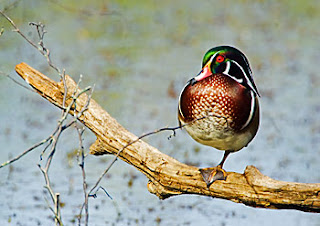
Male Wood Duck. Photo by Tim Springer,TX, 2007 GBBC participant
Scientists use the counts, along with observations from other citizen-science projects, such as the Christmas Bird Count, Project FeederWatch, and eBird, to give us an immense picture of our winter birds. Each year that these data are collected makes them more meaningful and allows scientists to investigate far-reaching questions.For highlights of past results, visit the Science Stories section of the GBBC web site.


http://www.whatbird.com/

http://www.birding.com/bird_identification.asp

http://www.wild-bird-watching.com/birds.html

http://davenation.com/birds/

http://www.attractwildbirds.com/identifybirds/most-common.htm


http://www.emporia.edu/ksn/v42n2-february1996/birds.htm

Monday, February 11, 2008

Baby Chicks

We ordered our chicks from Ideal Poultry this year. The customer service over the phone has been excellent so far, and the chicks arrived healthy two days after shipping. We ordered 25 chicks, and we have lost one, and I haven't figured out why she died. I spend a lot of time fussing over them, making sure their water is clean and that they have plenty of food and I also talk to them a lot. Right now we have 8 chickens in the coop, and I love when they follow me around outside looking for treats. They make musical chirps, it is a beautiful sound! I keep them in a refigerator box with pine shavings, a 250 watt light bulb and the box is also next to a baseboard heater which is set on low. There is plenty of room for them to run around, but I would not place more than 25-30 in a box this size. I always make sure to spray our shoes with Lysol when we come in and I always wash my hands when I come in from caring for my chickens outside.
Here is some more information on raising baby chicks!

http://www.kountrylife.com/content/how15.htm

http://www.mypetchicken.com/ebook.aspx?Chapter=4

http://www.upc-online.org/caring_for_chicks.html

http://www.strombergschickens.com/stock/chick_care.php


Friday, January 25, 2008

Cleaning the Chicken Coop


Winter is a good time to clean out the coop. The weather is cold and I think it makes it easy to tolerate this sometimes unpleasant chore. I didn't mind doing it, I actually enjoy chores around the farm. I love my chickens and I love giving them a nice clean place to lay their eggs, sleep and eat. They don't spend too much time in the coop, because we let them out every day to roam around the farm.

We are planning to make some renovations to the coop. The hen that you see in the picture is sitting on the loft, and I want to change the area underneath the loft into a nursery area for baby chicks, or for a hen and chicks in case any of my hens go broody. I am also going to build nest boxes and we will need another roost too. I can't wait to order more chicks! I am reading a great book right now by one of my favorite authors Carol Ekarius called Storeys Illustrated Guide to Poultry Breeds. There are lots of great photos and information on chickens. We have decided that we are going to order more laying hens, more broilers to eat and maybe even a few chickens that are rare. Here are some web sites about chicken coops!


Tuesday, December 18, 2007

Meet Big Red

Big Red is our head rooster. We have three roosters right now. Red watches carefully over all the hens. He warns them of danger, and when he finds food he calls to them with a beautiful clucking call. I love to watch him. He doesn't share his hens with the other roosters, and if they try to get too close to the hens he chases them off. There have been some scuffles when the white rooster tries to challenge him, but he has won every battle so far. If you are going to have laying hens I highly recommend one rooster, and no more for your hens. If you have a large number, say over 20 then you may want two of them. Choose your breed carefully especially if you have small children. Right now we have three roosters. The Silver Laced Wyandotte had gone after me and my four year old, so he will be turned into chicken soup soon.
I am almost positive that Big Red is a New Hampshire Red. I didn't order him, I just bought him at the local Farm and Garden store. If something happens to him, I will definitely consider buying another one. So far he is very friendly even with my daughter. She has spent a lot of time with him because he is her chicken. She loves to hold him, and he does very well.
Here are some great sites. Some have information about breeds, and some sell chickens too.
Well, that should keep you busy for a while! I don't think that I will blog again until after the holidays so MERRY CHRISTMAS and HAPPY NEW YEAR!

Saturday, December 1, 2007

It's Never Too Early

I have started to pull out some old seed catalogs while I wait for the new ones to arrive in time for Christmas. I got an e-mail from Baker Creek today informing me that their 2008 catalog has been sent to the printers. Check it out at http://www.rareseeds.com/ There is nothing more exciting for the gardener than the arrival of colorful catalogs in the dead of winter when all is devoid of color and bare. I have great plans already. I have fallen in love with roses for some reason. Right now I have 4 rose plants. I think that I am going to learn how to propagate them so I can have more. Propagation is something I am fascinated with! The thought of cutting off a bit of a plant I love and growing it into another whole plant is so exciting! I dream of trellises filled with roses, and roses climbing onto the porch filling the house with sweet smells. I am also dreaming of pumpkin patches and lots of tomatoes and yummy lemon cucumbers for my plate. A winter without dreams is like a gardener without a bit of soil. Well, I am off to do some more dreaming. What are your plans for next year?

Sunday, November 25, 2007

The Snow Bird

The dark eyed junco arrived today! I was so excited. There were three of them foraging through the remains of my garden. I spread some seeds on the ground near the area
that I saw them, hoping this will encourage them to stay in the area for at
least a few more days! Here is some more information from enature.com


This lively territorial bird is a ground dweller and feeds on seeds and small fruits in the open. It also moves through the lower branches of trees and seeks shelter in the tangle of shrubs. Until recently the many geographical forms of this bird were considered separate species, but since they interbreed wherever their ranges meet, they are now considered one species.
description 5-6 1/4" (13-16 cm). This species shows much geographic variation in color. Typically, male of western population ("Oregon Junco") has black hood, chestnut mantle, white underparts with buff sides. Eastern male ("Slate-colored Junco") is dark slate-gray on head, upper breast, flanks, and upperparts, with white lower breast and belly. Both forms have pink bill and dark gray tail with white outer tail feathers conspicuous in flight. The pine forests of the Black Hills in western South Dakota and eastern Montana have an isolated population ("White-winged Junco") similar to the eastern form but with 2 white wing bars and extensive white outer tail feathers. Birds of the Southwest ("Gray-headed Juncos") are gray overall, with a reddish-brown back. Female "Oregon Junco" has gray hood; females of all forms less colorful.